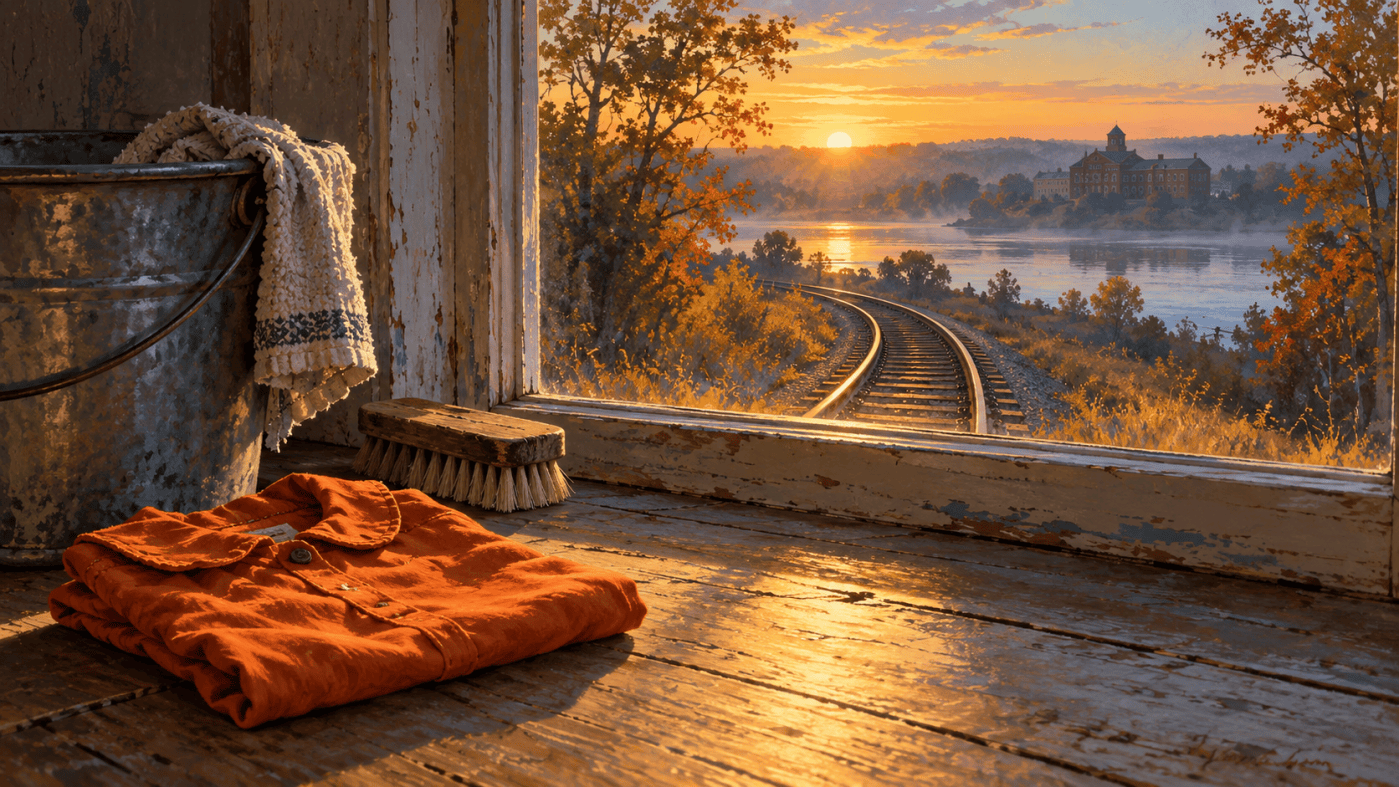
“…We may be Indian, but by God we ain’t dirty!” (Pember 16) The author, Mary Annette Pember, is quoting her mother, a survivor of St. Mary’s Indian Boarding School (Odanah), located on the Bad River Reservation and run by the Franciscan Sisters of Perpetual Adoration. She is referencing her mother’s obsessive compulsion to clean and also referencing the nuns at the boarding school her mother also calls “the sister school.”
Calling indigenous Americans “dirty Indians” was not uncommon. Before my brother and I were shipped off to Holy Childhood School in Harbor Springs, Michigan, and even after that, there were at least two or three adults in our neighborhood that said I would never amount to anything and that I was just a “dirty little Indian.”
Today is Wednesday, September 30, 2026 and it is Orange Shirt Day, a day of remembrance for those who went to the boarding schools, as well as those affected directly or indirectly. Phyllis Webstad is the woman behind Orange Shirt Day and “Every Child Matters.” As a boarding school survivor, she had her brand new orange shirt taken away and that marked the beginning of how that school experience affected her, as it did so many of us out here.
Recently, we had three talking circles at Northern Michigan University that were focused on remembering the Native American children who went to the boarding schools and Orange Shirt Day. The talking circles focused on three aspects of the seven grandfather teachings, those being Truth (Debwewin), Courage (Aakde’win), and Love (Zaagidwin).
Medicine River by Pember covers all three of those aspects. I also believe that anybody who is talking about their boarding school experience, whether directly or indirectly through a parent or loved one, has courage to do the research and the bravery of looking into those experiences. In fact, in the third session of the talking circle, which was on Love (Zaagidwin), it occurred to me that, in her way, Pember’s book was a love letter to her mother.
Love letters are not always about saying “hey man, I love you.” Sometimes, the love hides behind the effort and the meaning of the letter. Sometimes, it’s about doing all the research and facing all the atrocities that made your mother seem crazy and obsessive with cleaning, all the while muttering (or affirming), “…but by God, we ain’t dirty!”
In my personal experience with the boarding school, I felt rejected by my mother because she was dumping us off at this strange building in a strange city so many hours away from home. The longest I had been away from our house was two nights or a weekend at my grandmother’s or a long weekend with my dad who lived in another part of the state.
I can also tell you that 10-year-old was so hurt and even more, pissed off! I remember making the conscious decision my mother would no longer tell me what to do or tell me how to be in this world. Even though my brother was with me. It was probably my brother being there that kept me somewhat sane, because I felt protective of the little guy two years, my junior.
I wish I could tell you that a 10-year-old making a decision that nobody was gonna tell her what to do especially her own mother, that everything turned out OK. But that boarding school experience and sense of abandonment made me stubbornly independent.
Pember says some of the students going to boarding schools were not always taken away, but sometimes it was a childcare choice for the parent or parents (74). How is it that I am now a 64-year-old woman, fully realizing for the first time that my mother was making a childcare choice by sending us to Holy Childhood? She was a single parent struggling to keep two kids in school. On any given day they were taking a right towards the railroad tracks for an adventure, instead of taking a left two city blocks towards Straight School. Sadly, I feel that both of us, my mother and me, have spent most of our lives “tolerating” one another. I have also felt intensely driven to be accepted by her and everyone else at times.
While this class has been very challenging for me, reading Medicine River, watching movies and documentaries about the boarding school experience, it has opened the floodgates of pain but also, to reconciliation, if only with my own mother, where it all begins for me. I’m willing to face the tears, hear the truth, hold on for courage, and embrace the love that will help heal those old wounds that seem to stem from that year at Holy Childhood.
I don’t think any of us have the full answers yet. The boarding school experience still affects the people who are still alive, the relatives of the children that were buried in mass graves, the children whose parents or grandparents had that experience, and somehow are still affected by it whether it’s rejecting culture, not wanting to talk about it, rejecting Christianity, going back to Christianity while feeling guilty, and still trying to reconcile everything.
Sometimes saying you’re sorry is enough. But I’m not sure that there are enough sorries to make up for the damage that is still evident in our community. All we can do is heal one person at a time and hopefully that stain will eventually wash out. Taking this class has been like taking a scab off an old wound. Yes it’s still there bleeding and I don’t have the answers how to heal exactly. But at least right now I’m still here. My people are still here. And there’s a resurgence in reclaiming our culture and finding our way in the outside world as well.
Works Cited
Pember, Mary Annette. Medicine River: A Story of Survival and the Legacy of Indian Boarding Schools. Pantheon, 2025. Kindle.
Written for NAS 315 History of Indian Boarding School Education, Northern Michigan University, Fall 2026.


Leave a comment